
Education
How to Score 99 Percentile in JEE Main 2026?

Every year, hundreds of thousands of students take the Joint Entrance Examination Main and hope to get a score in the 99th percentile. At first, it sounds scary. But if you look closely at how the best students study and take the test, you’ll see that the goal is far more realistic than most students imagine.
You don’t have to answer every question to get a score in the 99th percentile. It takes a lot of hard work, smart practice, and discipline to stick to a defined plan for months.
Begin with a solid base
The questions in the JEE Main test are based on what you learned in school. The National Council of Educational Research and Training’s curriculum is almost entirely the basis for the JEE Main syllabus.
You already have a strong base if you know the basics from Class 11 and 12.
Instead than memorizing formulas, try to comprehend the ideas behind them. When you read a chapter:
- Take your time reading the theory.
- Know why each formula works.
- Before going on to harder problems, make sure you can solve the easier ones.
Students who want to get into the 99th percentile usually solve 150 to 200 problems per chapter, covering all levels of complexity.
Give more importance to chapters with high weightage
Not all chapters are equally important for the test. When you prepare smartly, you put the most important issues at the top of your list.
Here are some chapters that got high scores:
Physics
- Electricity
- Physics of Today
- Electricity and magnetism Thermodynamics
- Ray Optics and Chemistry
Chemistry of the Body
- The Mole Idea
- Thermodynamics of Chemicals
- Electrochemistry
- Chemistry of Living Things
- Hydrocarbons
- Ketones and aldehydes
- Biomolecules
Chemistry of Things That Aren’t Living
- Compounds that work together
Calculus, Chemistry, and Math
- Geometric Coordinates
- 3D Geometry with Vectors
- Determinants and Matrices
If you know these things well, you can write a lot of the paper.
First, answer questions from the previous year
Many students make the mistake of going straight to hard reference books.
Instead, begin with questions from last year’s JEE Main.
For the previous ten years, the test has followed a rather set pattern. Doing these questions helps you:
- Learn about different types of questions
- Find ideas that come up again and again
- Get better at managing your time
It’s a good idea to answer the last 15 years’ worth of queries per topic.
Once you feel ready, start taking full-length practice tests.
Get used to taking a mock test
The most important thing you can do to get ready is take practice tests.
Before the test, a student who wants to be in the 99th percentile should take at least 40 to 60 full mock tests.
Do this every day:
- Take one practice test.
- Spend a few hours looking at it.
- Find the weak spots.
- Change those ideas.
- Try another test.
The analysis stage is where most of the work gets done.
After each test, ask yourself:
- What questions did I spend too much time on?
- What ideas weren’t clear?
- Where did I mess up my calculations?
Getting rid of these mistakes little by little brings your score closer to the 99th percentile area.
More than attempts, accuracy matters
The JEE Main grading system promotes being right.
- Correct answer: +4 points
- Wrong answer: −1 mark
Negative marking means that random guessing can lower your percentile.
Instead of trying all 75 questions, top scorers frequently try 60 to 70 questions with a high level of accuracy.
A good goal is:
- Try: 65 questions
- 85% or more correct
Most of the time, this combination results in a score that is considerably above the 99 percentile mark.
Set up a daily study schedule
It’s more important to study regularly than to study for large periods of time.
This is what a useful daily schedule might look like:
- Morning: Learning about ideas and theories
- Afternoon: Practice solving problems
- Evening: Reviewing and looking for mistakes
Students who are really serious about getting ready often study for 6 to 8 hours a day outside of school or coaching.
But the quantity of hours isn’t the most important thing. The most important thing is to have productive hours without interruptions.
Keep making changes often
Keeping what you learn is one of the hardest parts of being ready for the JEE.
In two years, students read hundreds of chapters. Without review, earlier subjects vanish fast.
Follow this simple rule for revision:
- Change it after one day.
- Change it after a week.
- Change after a month.
Short review sessions help you remember formulas and ideas.
Many toppers also keep a journal of mistakes. When you get a question wrong, jot down the idea and the mistake. It’s quite helpful to look over this notebook before practice examinations.
Take care of stress and burnout
Sometimes, getting ready for the JEE can be too much. Pressure comes from long study hours and competition.
But mental stability is vital for doing well consistently.
Some easy things to do help:
- Get at least seven hours of sleep every night.
- Study for brief periods of time.
- Walk or do some kind of exercise for 20 minutes every day.
- Don’t keep comparing your preparedness to others’.
Keep in mind that the test checks for clarity and attention. Being tired makes both worse.
The Last Three-Month Plan
The last three months before the test are really important.
Instead of learning new things, work on improving what you already know.
At this point:
- Go over the whole syllabus at least twice
- Do three practice tests a week
- Look at mistakes very carefully
- Pay attention to your weak points
Also, practice solving papers at the same time as the test to help you stay focused during the real thing.
Final Thoughts
Getting a score in the 99th percentile on the JEE Main is hard, but not impossible.
Every year, students do it not because they are superhuman, but because they stick to a strict plan:
- Powerful ideas
- Regular practice
- Analysis of the mock test
- Managing your time well
The goal of 99 percent becomes possible if you start early, keep going, and focus on understanding instead of memorizing.
Getting ready for the JEE doesn’t mean studying all the time. It’s about learning how to study.And if you use the appropriate plan for the following few months, you can definitely get that 99 percentile score.
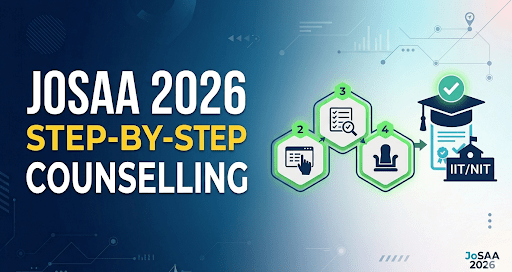
After giving JEE Main, students start to feel a mix of relief and confusion and often wonder what happens next? In 2026, JEE Main Session 1 was held from January 21 to 29, 2026, and Session 2 will be held from April 2 to 9, 2026. After both sessions are over, the final result is released, and this is where the admission process begins.
The next big step is JoSAA counselling, conducted by the Joint Seat Allocation Authority. In simple terms, JoSAA counselling is the process through which students get admission into colleges like IITs, NITs, IIITs, and other government engineering colleges. They have to register, fill out their college and branch choices, and based on their rank, they are given a seat. This step is very important because it decides students’ college and course. In this guide, everything is explained in a simple way, so they clearly know What To Do After JEE Main 2026.
What is JoSAA Counselling?
Joint Seat Allocation Authority counselling is the process through which students get admission into top engineering colleges like IITs, NITs, IIITs, and other government colleges. After the JEE Main Result is declared, eligible candidates need to take part in this process to get a seat.
In simple terms, JoSAA counselling is where students register, choose their preferred colleges and branches, and get a seat based on their rank. It is an important step because it decides which college and course a student will attend.
JoSAA Counselling 2026: Expected Dates
The counselling process usually starts soon after the JEE Main results are declared. The registration for this counselling is expected to begin in June 2026, followed by choice filling and locking. Finally, the authority releases the seat allotment based on candidates’ ranks, preferences and availability of seats. The seat allotment happens in multiple rounds, so even if a student does not get a seat in the first round, there are still chances in later rounds.
| Event | Expected Date (2026) |
| Registration Starts | June 2026 |
| Choice Filling & Locking | June 2026 |
| Round 1 Seat Allotment | June 2026 |
| Round 2 Seat Allotment | June/July 2026 |
| Further Rounds | July 2026 |
| Final Admission | July 2026 |
Step-Wise Process for JoSAA Counselling
The JoSAA Counselling process for the year 2026 will include the following steps: online registration, choice filling, choice locking, seat allotment, seat acceptance & fee payment, document verification, and final admission. Given below is the step-wise process for JoSAA counselling:
Registration: Students need to first register on the JoSAA portal using their JEE Main details. This step is required to take part in the counselling process. Candidates should enter all details carefully and make sure everything is correct before submitting.
Choice Filling: After registration, candidates need to select colleges and branches. Students can choose from IITs, NITs, IIITs, and other colleges. It is always better to fill as many choices as possible to improve the chances of getting a seat.
Choice Locking: Once all choices are filled, candidates must lock them before the last date. If not locked, the system may lock them automatically. After locking, no changes can be made, so students should check everything properly.
Seat Allotment: JoSAA releases seat allotment results in different rounds. Seats are given based on rank, category, and choices filled by the candidates. Students can check their allotted college and branch online after each round.
Seat Acceptance & Fee Payment: After getting a seat, candidates need to accept it by paying the required fee. This confirms that the student is interested in the seat for College Admission. Students can also choose options like Freeze, Float, or Slide based on their preference.
Document Verification: Candidates need to upload and verify their documents after fee payment. Important documents include marksheets, scorecards, and ID proof. This step is important to confirm the student’s eligibility.
Final Admission: After all rounds are completed, students who are satisfied with their seats need to report to the college. This step completes the admission process, and students can then begin their college journey.The next step for What To Do After JEE Main 2026 is to take part in the Joint Seat Allocation Authority counselling to get a college. The process is simple and works step by step, from registration to final admission. Candidates should follow all steps on time, fill in their choices carefully, and keep all documents ready. Regularly checking updates is also important to avoid missing any step. With the right steps and careful choices, candidates can get into a good college and start their next journey with confidence.
Preparing for competitive tests such as the Joint Entrance Examination Main and the National Eligibility Cum Entrance Test has never been simple. There is a lot to learn, the competition is tough, and students often feel that they don’t have enough time.
But getting ready today is drastically different from how it was even five years ago.
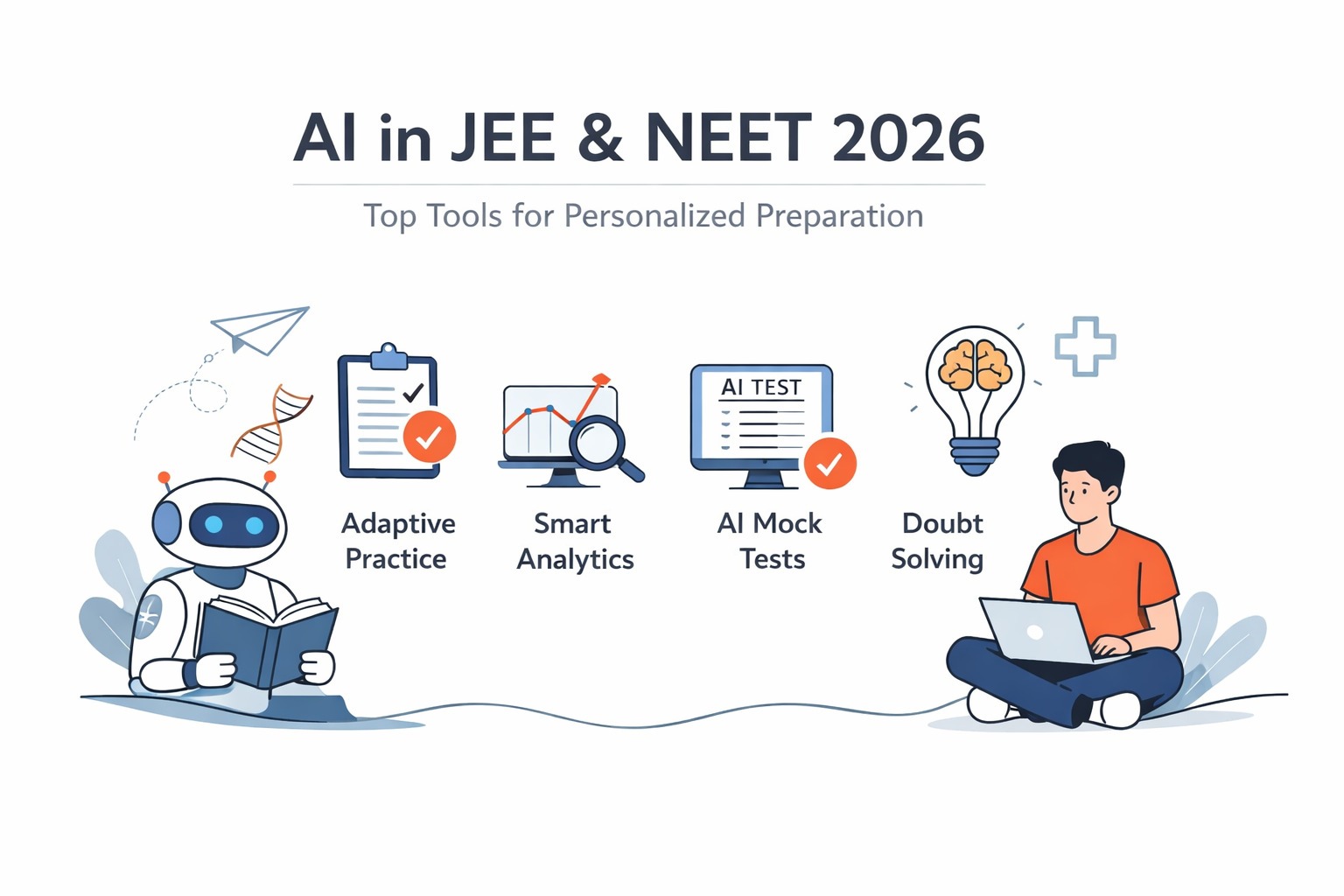
AI is slowly transforming the way kids learn. AI tools are helping students learn quicker and practice smarter, from answering problems right away to making individualized study regimens.
This doesn’t mean that AI handles all the job for you. It gets rid of a lot of the little things that slow kids down when they are getting ready.
This is how AI tools are helping people who want to take the JEE or NEET exams study better.
Students Don’t Have to Wait Hours to Ask Questions Anymore
One of the hardest things about being ready for an exam is finding answers to questions quickly.
In the past, students had to wait for the next coaching class or look through a lot of books to figure out one confusing idea. A little hesitation can often make a whole study session take longer.
That is changing with AI-based learning aids.
Students can now type in a question or upload an issue and get fast step-by-step answers. This is especially useful in fields like math and physics where one idea is often linked to several others.
Students can quickly understand difficulties without losing their study momentum with tools like Photomath and ChatGPT.
Students learn more and feel less stuck when their questions are answered right away.
AI Makes Study Plans That Are Unique to Each Person
Many students stick to the same strict routine, no matter what their skills and shortcomings are. That method doesn’t always work.
Some kids have a hard time in Physics but do well in Biology. Some people might need to practice Organic Chemistry or Calculus more.
AI-powered platforms look at how well students do on tests and automatically propose study strategies based on how well they are doing.
BYJU’S and Unacademy, for example, keep track of how well students do on quizzes and practice tests. The system then suggests chapters that need more work.
Students don’t have to guess what to study next. They know exactly what to do.
This makes getting ready more organized and effective.
You Can Make Practice Questions Right Away
To do well in the JEE and NEET, you need to practice.
But there are limits to traditional question banks. Students often do the same issues over and over again after they finish them.
AI tools may quickly make new practice questions based on a subject or level of difficulty.
AI systems can quickly construct new problem sets for students who require additional questions on electrostatics or chemical equilibrium, for example.
This allows pupils as many chances as they want to practice and get better at it.
Students are also better prepared for unexpected patterns on the real test when they practice with a wider range of questions.
AI Helps Us Look at Mock Tests More Closely
It’s vital to take practice tests, but it’s much more important to look at them the right way.
A lot of pupils only look at their scores and then go on. That means they miss out on useful information.
AI-based analytics can give a lot of information about how well someone did on a mock test.
Students can see:
- Which chapters have the most errors
- How long does it take to answer each question
- If accuracy goes down in certain subjects
- Which kinds of questions are often answered wrong
This kind of examination helps pupils quickly repair things that aren’t working.
Students can focus on the areas where they need to improve instead of revising randomly.
Flashcards With AI Help You Study Better
Revision is a big problem for students who are getting ready for competitive exams. Over the course of two years, the JEE and NEET syllabuses cover hundreds of ideas.
AI tools aid by making smart flashcards and fast summaries for review.
Apps such as Anki use spaced repetition algorithms. These approaches show pupils hard ideas more often and easy ones less often.
This method helps you remember things for a long time and makes it less likely that you’ll forget important formulas, reactions, or biological words.
This strategy can be quite helpful for areas like biology and inorganic chemistry.
AI Makes Hard Concepts Easier to Understand
Not all students grasp things the same way. Some people learn better when they see things, while others learn better when they see examples.
AI learning systems can show you the same thing in several ways.
For example, you may use step-by-step logic, real-world examples, or simple summaries to explain a thermodynamics idea.
This flexibility makes it easier for kids to learn new things.
They don’t have to read a chapter over and over again. They can look at it from a different angle until it makes sense.
AI Helps Students Manage Study Time Better
One of the hardest things about getting ready for a tough exam is managing your time.
A lot of students spend too much time on some chapters and not enough on others.
AI-based study trackers keep track of how long students spend on each subject and how well they do during those times.
They can suggest:
- When to take a break
- What subject do you need to work on more?
- How to keep Physics, Chemistry, and Biology in balance
These tiny changes make study sessions work better.
That efficiency can save hundreds of hours after months of planning.
AI Makes Learning of High Quality Available Anywhere
Not every kid can get to the best coaching centers.
AI-powered learning platforms help fill that gap.
Using a smartphone or laptop, students can get high-quality explanations, practice problems, and performance analysis from anywhere.
This gives students from smaller towns and rural areas a better chance to compete with students from big cities.
Technology can’t get rid of competition, but it can provide more kids access to valuable resources.
AI Is a Tool. Not a Quick Way
AI is not a miracle answer, even with all of these benefits.
You still need to study regularly, have a solid foundation, and practice regularly to do well on tests like the JEE and NEET.
AI is just a really helpful tool.
It helps students stay focused, clear up questions more quickly, and find their deficiencies sooner.
But the learner still has to put in the work, be disciplined, and keep going.
Getting Ready for Tests in the Future
In the next few years, AI will play a bigger and bigger role in education.
Tools in the future may have even more advanced capabilities, such learning routes that change based on how well you do, smart mock tests, and coaching on how to do better in real time.
Students who are getting ready for school today can get a big advantage by learning how to use these tools well.
AI can help you get ready for the JEE and NEET tests faster, more focused, and with less stress when you combine it with hard work and good study habits.

Every year, hundreds of thousands of students take the National Eligibility cum Entrance Test with one clear purpose. Getting into a reputable medical school.
When you’re just starting out, the preparation process can be complex. There is a lot to learn, a lot of competition, and a lot of pressure to study more all the time.
But the truth is easy to understand. Most pupils who do well don’t use sophisticated tactics. They focus on a few simple habits and do them over and over for months.
This article will help you make a useful plan from the outset if you are getting ready for NEET 2026.
NCERT Can Help You Build Your Base
The textbooks from the National Council of Educational Research and Training are the best thing you can use to get ready for the NEET.
A lot of the questions in the NEET test stem straight from NCERT ideas, notably in Biology and Chemistry.
For beginners, the best way to go is simple.
- Take your time and read NCERT thoroughly.
- Make sure you understand each diagram and example.
- Make the crucial lines stand out.
- Make changes to the chapters often.
Students sometimes switch to different reference books too soon. That frequently makes things less clear instead of more clear.
A thorough comprehension of NCERT is the basis for everything else.
Make Biology Your Best Subject
Half of the total marks in NEET are for biology. That means it has the most points.
Most people who achieve high scores in Biology attempt to get as close to 340 out of 360 points as possible.
To do it, you need to focus on three things.
First, read the NCERT one line at a time. A lot of the questions are based on little aspects in the book.
Second, work on a lot of Biology questions. This helps you recall ideas and see patterns.
Third, go over things often. Biology has a lot of facts, and going over them over and again helps you remember them.
Getting a high score in Biology can really help your overall rank.
Don’t Ignore Physics Even If It’s Hard
A lot of novices don’t like Physics. The numbers and calculations can seem scary at first.
But not studying Physics simply makes things worse.
Instead, work on grasping the ideas one step at a time.
Start with simple subjects like:
- Laws of Motion and Motion
- Power, Work, and Energy
- Electricity at the Moment
- Physics Today
First, answer the easy questions. Once you understand the basics, move on to issues that are a little harder.
In the beginning, consistency is more important than speed.
Keep the Chemistry Right
There are usually three parts of chemistry in NEET.
Physical Chemistry
Organic Chemistry
Inorganic Chemistry
Each segment needs a somewhat different way of doing things.
Physical Chemistry is all on numbers and formulas. To get better in speed and accuracy, practice often.
You need to know how reactions work and what patterns they follow to do organic chemistry.
The main focus of inorganic chemistry is theoretical. For a lot of questions, just reading NCERT thoroughly is generally enough.
A balanced approach helps you do well in all areas.
Practice Questions From Last Year
One of the best things novices may do is start working on NEET questions from prior years.
These questions illustrate what kinds of ideas the test covers and what subjects come up a lot.
You can help yourself by solving them:
- Know how the test works
- Recognize ideas that come up again and again
- Boost your self-esteem
It’s a good idea to go over queries from the past 10 to 15 years by topic.
Just this one habit can make a big difference in how well you prepare.
Make a Simple Study Schedule for Each Day
A lot of students fail not because they aren’t smart, but because they aren’t consistent.
A realistic daily schedule makes getting ready easier.
For instance:
Morning. Learn new things
Afternoon. Practice questions
Evening. Go over what you learned before
Most beginners need to study for 6 to 7 hours a day outside of school or coaching.
The idea is not to study all the time. The idea is to study consistently without taking extensive breaks to get ready.
Every day, even small improvements adds up to big outcomes over time.
Take Mock Tests Early
Mock tests are very important for getting ready for the NEET.
They help you get used to the test setting and teach you how to manage your time better.
A lot of beginners wait until the last several months to take tests. That’s not the best.
Instead, begin with tests for each chapter and then go on to full-length mock tests.
Before the test, a decent goal is to try to do 30 to 40 entire mock papers.
Take some time after each test to reflect on your mistakes. Most of the time, this is where the most progress is made.
You Should Review Every Week
The NEET syllabus is rather long. If you don’t review regularly, old themes go away soon.
A easy way to review works great.
- Change the subject the next day.
- After a week, change it again.
- After a month, go over it again.
Short study sessions can help you remember things better and feel less stressed about tests later.
A lot of pupils also keep a journal for mistakes. Writing down mistakes helps you not make the same ones again.
Take Care of Your Health and Stay Focused
Getting ready for NEET takes a long time. It’s crucial to keep your body and mind healthy.
Here are some easy things you can do to help:
- Get at least seven hours of sleep every night.
- Take small breaks as you study.
- Get enough water.
- Every day, get some exercise or go for a walk.
Don’t always compare how far you’ve come with others. People learn at different speeds.
You can study better if you stay calm and focused.
Last Thoughts
At first, getting ready for NEET 2026 may seem like a lot of work. But if you do it the proper way, it gets a lot easier.
- Concentrate on the basics.
- Have faith in NCERT texts.
- Do it often.
- Take practice tests and learn from what you did wrong.
- Always go over your work.
Every year, thousands of students use this simple plan to get good grades.
You can reach your goal of passing NEET 2026 and getting into medical school by taking small steps every day.
For a long time, there was just one way to get into an Indian Institute of Technology. Pass the JEE Advanced test once you’ve aced the JEE Main. Although there are other entry points, the exam is still the most common.
There are now new programs at several IITs that do not require JEE for entrance. Artificial intelligence, data science, and multidisciplinary technology are some of the modern disciplines that these studies center on. Students from a variety of academic backgrounds, working adults, and those seeking more flexible online learning options are the target audience for many of these programs.
If you believed that getting into IIT would be impossible without taking the JEE, you would be wrong. Who may apply, what the admissions procedure is like, and what new IIT courses are available without JEE are all detailed in this article.
Why IITs Are Offering Courses Without JEE?
Originally designed for undergraduate engineering programs, the conventional IIT admissions process has since evolved. While it is effective for Bachelor of Technology programs, it is not applicable to all educational paths.
Nowadays, proficiency in technology is required by:
- Working individuals
- Recent grads who did not major in engineering
- Individuals making a career change
- Students looking for shorter or more adaptable courses
Online degree, certificate, and executive course offerings from IITs were a direct response to this need. Rather than relying on the conventional entrance exam, these programs value practical industry experience.
Admission is based on academic background, online examinations, or qualifying exams rather than JEE results.
Well-Known IIT Programs That Don’t Need JEE
Some prestigious IIT programs do not require the Joint Entrance Examination (JEE).
BA in Data Science from IIT Madras, Earned Online
The Online Bachelor of Science in Data Science and Applications programme at IIT Madras is a hot topic.
Important things to remember:
- Streamlined curriculum
- Level 12 graduates are welcome
- Does not necessitate JEE
- Qualification for admission
A quick online foundation course is required of all students. After successfully completing the qualifying exam, students are advanced to the degree program.
Thousands of students, both domestic and international, have expressed interest in this program.
Digital Certificate Programs at IIT Delhi
IIT Delhi’s continuing education platform provides access to a wide variety of online degree programs.
Commonly used areas encompass:
- Data analysis
- Data security and machine learning
- overseeing the product
Usually, these types of classes demand for:
- An undergraduate degree
- The ability to do basic math or programming
- Screening applications or quick assessments
Their primary target audience consists of working professionals looking to hone their craft.
Executive Courses Offered Online at IIT Roorkee
The following are some of the executive certification programs available at IIT Roorkee:
- Machine learning
- technology in the cloud, digital advertising, and the blockchain
The standard admissions criteria are:
- Completion of studies at an accredited institution
- In certain instances, job experience
Online classes, homework, and real-world projects make up these short courses.
Masters Degree Programs at IIT Kanpur
The eMasters programs, offered by IIT Kanpur, are highly specialized online postgraduate credentials.
Important traits:
- Requires neither GATE nor JEE.
- Made specifically for busy professionals
- Invest in niche markets such as cybersecurity, artificial intelligence, and financial technology.
Selection is determined by:
- Prior education
- Job history
- Online evaluation
You can also use the credits from these programs to apply for graduate school in the future.
Enrollment in IIT Programs Without the JEE
Although every IIT program is unique, there is a general outline that the majority of them adhere to.
Fill Out an Online Application
The first step for prospective students is to visit the IIT website and complete the application form.
Standard information needed:
- Data pertaining to an individual
- Historical research
- Disclosure of financial involvement
- Application materials for professional courses
There may be a nominal application fee for certain programs as well.
Verification of Eligibility
Before admitting anyone, the institute checks if they fulfill the minimum requirements.
Standard necessities consist of:
- Final exam score (for online bachelor’s degree programs)
- Degree at the bachelor’s level (to enter graduate school)
- Proficient in basic computer science or maths
Students from any major, including the arts and business, are welcome to enroll in some classes.
Conduct a screening or qualifying test.
A qualifying exam is used by many IIT programs in lieu of JEE.
The following topics are covered in a basic knowledge test:
- Mathematics
- reasoning through logic
- computer science foundations
- data analysis
On average, it’s far easier than JEE.
An example of this would be the foundation qualifying exam that follows a brief training module in the Data Science program at IIT Madras.
Course on Foundations
In order to get full admission to certain programs, students must first finish a prerequisite course.
At this point, they get the chance to show that they can manage the course material.
Students finish the following tasks during this time:
- Streaming video lectures
- homework every week
- tests and examinations
The whole program is continued by students who pass.
Successful Enrollment
Students are formally admitted after they pass the qualifying round.
They are able to access:
- whole set of course materials
- lecturers from IIT
- digital laboratories
- communities of learners
Campus visits or immersion programs are also offered as optional components of some programs.
Cost and Length of the Course
How long it takes is program-specific.
Regular schedules:
- Concise credentials. 30 to 36 weeks
- program for executives. 8 to 12 weeks
- online degrees. between three and four years long
Traditional IIT degrees also have various fees.
Examples:
Certificate programs that are not too long. 2,000,000 to 250,000 rupees
program for executives. between 2 and 5 lakh
degree programs offered entirely online. most of the time spanning more than one level
The prices are substantial, but they are typically less than those of many private foreign programs.
Conclusion
Students can now get into IITs in ways other than passing JEE Main and JEE Advanced. For example, Indian Institute of Technology Madras has started new programs that provide students more options. These classes teach you many technical skills without the stress of national admission tests.
If you want to work in data science, programming, or analytics, these programs are a great way to study from IIT experts and get skills that are useful in the real world without having to take the JEE.
Engineering and medical entrance examinations in India are among the most competitive academic tests. Exams such as the Joint Entrance Examination (JEE) Main, Joint Entrance Examination (JEE) Advanced, and National Eligibility cum Entrance Test (NEET) require strong conceptual clarity, rigorous practice, and strategic preparation Self-study is important, but many people prefer to pass the pick coaching schools since they offer structured help, expert advice, and a lot of study materials.
Many coaching centres in India have a strong reputation for helping students get into top schools such as the Indian Institutes of Technology and top medical universities. These are some of the best coaching centres known for helping students prepare for JEE and NEET.
Allen Career Institute
One of the best coaching centres in India for JEE and NEET preparation is Allen Career Institute. Allen started in Kota, Rajasthan, but has since grown to include many locations and online platforms. The school is known for having experienced teachers, well-organized academic programs, and a long history of getting students to high positions.
Allen offers specialized classes for people who want to become engineers or doctors. Their programs are centered on learning concepts, taking tests on a regular basis, and analyzing performance in depth. Students also benefit from study resources that cover everything and sessions where they can ask questions. Many students who did well on both the JEE and NEET exams said Allen’s methodical approach helped them succeed.
The Aakash Institute
Aakash Institute is another well-known name in coaching for medical and engineering students. Aakash has become very popular among NEET hopefuls because it has hundreds of branches all over India. The school has well-planned classroom programs, integrated school programs, and digital learning opportunities.
Aakash emphasises laying a strong foundation in Physics, Chemistry, and Biology. Students can figure out what they’re good at and what they need to work on through regular practice tests, performance-tracking tools, and skilled teachers. Over the years, Aakash students have performed very well on NEET and other difficult tests.
Resonance
Another well-known coaching school that started in Kota is Resonance Eduventures. Resonance is well-known for helping students get ready for engineering entrance exams, especially JEE Main and JEE Advanced. The school is noted for its in-depth study modules and tough practice sessions.
Resonance offers classroom programs, distance-learning courses, and online study tools. They place a lot of emphasis on teaching students to solve problems and to deeply comprehend concepts. Students can keep on track with the exam structure and difficulty level by taking practice exams and analyzing their performance on a regular basis.
FIITJEE
FIITJEE is well-known for helping students get ready for engineering entrance exams. The institute started in Delhi and has since grown to have a strong presence in many big cities. FIITJEE is best known for its creative teaching methods and its programs that work with schools.
The school stresses analytical thinking and sophisticated problem-solving. The study resources are made to be very similar to the JEE tests. FIITJEE helps students gain the confidence they need to take highly competitive tests by offering regular tests, feedback sessions, and one-on-one mentoring.
Motion Education
Motion Education has become a prominent competitor in the coaching business. The institute is located in Kota and is known for having high-quality teachers and well-organized academic programs for people who want to take the JEE or NEET.
Motion Education conducts classes in person, online, and by mail. Their teaching method is built on making concepts clear, learning through practice, and giving tests regularly. The school has consistently done well on national-level entrance exams.
Narayana Coaching Center
Narayana Coaching facilities is part of the Narayana educational group, which runs thousands of schools and coaching facilities in India. People remember the school for its strict academic standards and rigorous physical activities.
Narayana offers courses that combine schoolwork with preparation for entrance exams. This method helps pupils do well on both board exams and competitive tests. The institute’s planned curriculum and regular tests ensure steady progress.
How to Pick the Best Coaching Institute
For people who want to take the JEE or NEET, choosing the correct coaching institute is a big deal. Students should consider factors such as teachers’ knowledge, the quality of the study materials, class size, outcomes from previous years, and the availability of help with questions. Location, cost, and the availability of online learning options are also significant factors to consider.
It is important to realize, nevertheless, that coaching alone won’t guarantee success. Self-study, disciplined practice, and good time management are all equally vital. Coaching centers give students help and tools, but how well they do in the end relies on how hard they work and how dedicated they are.
Conclusion
You need a solid plan and a lot of practice to prepare for tough tests like the JEE and NEET. Structured preparation programs from coaching centers like Allen, Aakash, Resonance, FIITJEE, Motion Education, and Narayana have helped thousands of students reach their academic goals.
With the correct mix of tutoring, disciplined study habits, and regular practice, people who want to get into top engineering and medical schools in India can greatly improve their chances of getting a high score.
NTA is not letting people who are applying during the extended period of JEE Main 2026 session 2 make changes to their applications. As a result, the JEE Main 2026 form correction window is still closed. The official website, jeemain.nta.nic.in, had a link to the JEE Main 2026 session 2 form rectification. Candidates had to enter their application number and date of birth to get to the rectification window. People who filled up the JEE Main form revision 2026 might change their or their parents’ names, academic information, exam city, medium, paper, basic information, and more until February 28, 2026, at 11:50 PM. The JEE Main test for session 2 will be held from April 2 to 9, 2026. In the post below, you may find out how to fix mistakes on the JEE Main Form 2026.
Link for correction of the JEE Main 2026 form
The deadline for the JEE application form 2026 for session 2 was February 25. After the form corrections are done, the NTA will send out the advanced JEE Main city intimation slip for session 2. Next, candidates can download the admit card for JEE Main Session 2. The JEE Exam’s first session took place from January 21 to 30, 2026. The candidates should read the post to find out how to access the URL to correct the JEE Main 2026 form.
Link to JEE Main Form Correction for Session 2 of 2026
The link to the JEE Main 2026 Session 2 form correction window was live on the official website. Candidates could access the rectification window for JEE Main 2026 Session 2 only once.
JEE Main 2026 Session 2 Applications – Click Here
JEE Main 2026 Session 2 Application Reopening Notification – Click Here
Highlights of the JEE Main 2026 Correction Window for Session 2
The table below outlines the process for correcting the JEE Main 2026 form. You can only do the process once, and it was all online. You could get the JEE Main rectification link for session 2 on jeemain.nta.nic.in.
| Particulars | Details |
| Exam Name | Joint Entrance Examination (Main) 2026 |
| Official Website | jeemain.nta.nic.in |
| Session 1 Form Correction Date | December 1, 2025 |
| Session 2 Form Correction Date | February 27, 2026 |
| Session 1 Form Correction Last Date | December 2, 2025 |
| Session 2 Form Correction Last Date | February 28, 2026 |
| JEE Main Login Details | Application Number and Password |
| JEE Main 2026 Exam Dates (Session 1) | January 21 to 30, 2026 |
| JEE Main 2026 Exam Dates (Session 2) | April 2 to 9, 2026 |
How to Make Corrections in JEE Mains 2026 Session 2?
The official website for the JEE Mains, jeemain.nta.nic.in, has opened the session 2 correction window. Students can find out how to use the JEE Main 2026 form rectification link.
To get to the JEE Main official website, click on jeemain.nta.ac.in into the search bar.
- The official website for JEE Main will open up.
- Under “Candidate Activity,” you will see the link to fix your JEE Main 2026 form.
- To correct your JEE Main form for 2026, click on the link.
- Type in the password and application number.
- A new screen will show the JEE Main 2026 form editing window.
- Go ahead and change the form.


Gimkit Join: How to Join a Gimkit Game Easily

Leo Skepi Age: How Old Is the TikTok Star in 2026?

Dm First Game Guide: Discovering DmFirst and the Dm First Club Platform

Best Gaming Website Wheon com Games in 2025

How to Generate Passive Income with 5starsstocks.com