
SIP
Open Demat Account and Use a SIP Calculator to Choose the Right Mutual Fund


Investing in a mutual fund is today’s most popular way of building wealth during the last few decades. But intelligent investment decisions require intelligent planning and suitable tools. Two essential steps in doing so are getting a Demat account and using calculation tools for assessing your investment choice in an appropriate manner.
Understanding the Importance of a Demat Account
If you choose to open demat account, you are basically opening a virtual locker for your securities. Your mutual fund units, shares, and other financial assets are kept in the virtual account and hence certificates become unnecessary. The entire process has become very simple with fewer documentation and verification processes that can even be executed online.
A Demat account is your ticket to the investment world. It allows you to invest in, sell, and monitor your mutual fund investments easily. With the account, you are directly provided with your portfolio statement, transaction statement, and dividend payments, hence it is convenient and easy to track your investment.
The Power of SIP Investments
Systematic Investment Plans is a systematic investment in mutual funds. You do not invest money all at once as a lump sum but invest a fixed amount at fixed intervals, say monthly. This method eliminates the effect of volatility in the market through rupee cost averaging, wherein you purchase more units at lower prices and less at higher prices.
SIPs encourage disciplined savings habit and offer the chance to invest to all income classes. You can start investing a mere five hundred rupees per month, which you can proportionately increase with your income.
Taking Well-Informed Decisions Using Calculation Tools
Before investing in any SIP, using a mutual fund SIP calculator is necessary to make appropriate decisions. Online sip calculators make it possible for you to understand how your systematic investments will become large amounts of money in a span of time with regards to different situations and prevailing returns. By providing the details of your monthly investment, investment tenure, and expected yearly return, you can view the possible future value of your investments.
These calculators also help you determine what investment is needed on a monthly basis in order to achieve certain financial goals. You are saving for retirement, a child’s college education, or a home; these calculators give you an idea of the investment requirements.
Choosing the Best Mutual Fund
Selecting the right mutual funds is a matter of prudent consideration of several factors. Large-cap funds tend to reflect stability, whereas mid-cap and small-cap funds provide scope for higher growth at higher risk.
Diversification across different funds will equalize risk and returns. Invest a mix of debt and equity funds based on your age and risk capacity. Young investors can invest in proportionally higher schemes of equity, while investors near retirement age can invest in debt schemes.
Conclusion
Remember that investments in a mutual fund involve market risk and history of a mutual fund’s performance does not guarantee future performance.
The combination of a good Demat account and sound investment decisions by using proper calculation tools provides a stable ground for mutual fund investments-based wealth generation.

One question keeps coming up when people want to invest in mutual funds. Should you use a Systematic Investment Plan to invest a little bit every month, or should you put in a lot of money all at once? Both methods can work, but the outcome relies on the time of day, the level of discipline, and the state of the market. A SIP vs. lump sum calculator can help you here. It lets you figure out which option is best for you by comparing returns.
What are SIP and Lump Sum Investments?
With a Systematic Investment Plan, you can invest a set amount of money on a regular basis, usually once a month. It makes your investment last longer. You don’t need a lot to get started.
Making a large investment in a mutual fund at once is called a lump-sum investment. This strategy relies heavily on market timing. You can make a lot of money if you invest when the market is low. If not, you might have to wait longer to see results.
How a SIP vs. Lump Sum Calculator Can Help
Based on inputs like these, a SIP vs. lump sum calculator evaluates the future worth of both methods:
- How much you invest
- Period of time
- Expected return rate
- How often you invest
You don’t have to guess; you can see the two options side by side. This makes it easier to make decisions, especially about long-term goals like saving for retirement or producing money.
The Main Difference That Affects Returns
The biggest distinction is when and how much risk you take.
With SIP:
- You put money into different market cycles
- You get the most out of rupee cost averaging
- You lower the chance of entering at the wrong time
With a lump sum:
- From day one, you are fully exposed to the market
- The returns you get depend on when you invest
- If the market goes up soon after you invest, you could make more money
An Example to Help You Understand Better
Let’s say there are two investors:
- Investor A puts ₹5,000 into SIP every month for 10 years
- Investor B puts in ₹6,00,000 all at once for 10 years
If you expect a return of 12% each year:
- As units are bought at varying prices, SIP investments continually expand
- If the market goes up early, the lump sum grows faster, but if it goes down early, it can take longer
A calculator will show that both can provide similar outcomes over a lengthy period, but the trip will be different.
Market Conditions Are Very Important
This is when the true difference comes out.
When the market is going up:
Because the full amount benefits from growth early on, a lump sum usually does better.
When the market is unstable or going down:
SIP does better because it spreads the expense of buying over time.
Many investors choose SIP because it’s hard to predict how the market will move.
Comparing Risks
People often think SIP is less risky, not because the market risk is reduced, but because the way the money is invested lowers the risk of timing.
Lump amount has more risk in the short run. A bad entrance point can affect returns for a long time. But if you invest during market drops, you can make a lot of money.
Who Should Pick SIP?
SIP is a good choice if:
- You get paid on a regular basis
- You want to learn how to be disciplined when you invest
- You like reduced timing risk
- You are putting money into things for the long run
It works successfully for most retail investors because it takes away the stress of having to choose when to invest.
Who Should Pick a Lump Sum?
If you want a lump sum:
- You have a lot of money ready to invest
- You know how the market works
- You are okay with taking a risk with timing
- You are putting money into the market while it is going down
Some people who invest use both tactics. They put some money in as a lump payment and the remainder through SIP.
What the Calculator Doesn’t Say
A SIP vs. lump sum calculator offers you figures, but it doesn’t take behavior into account.
For instance:
- A lot of people quit SIP when the market goes down, which lowers returns
- When the market goes down, people who invest in lump sums may panic and leave early
The method isn’t as important as being consistent. The ideal plan is the one you can follow through with.
Things to Think About When It Comes to Taxes and Costs
The tax treatment of both SIP and lump sum investments in mutual funds is the same, depending on the type of fund and how long you keep it. There isn’t a big difference in how taxes are handled for the two methods.
But SIP distributes your investment, so when you cash out, each payment may have a varied holding duration. This could have a small effect on how taxes are calculated.
Final Decision: Which One Gives Better Returns?
There isn’t just one answer.
- A lump sum can offer you more money back when the market is going up
- Over time, SIP can give you more reliable results
SIP is the safer choice if you’re not sure when to buy or sell. Lump sum can work well if you can find strong entry points and are okay with taking risks.
A Smart Approach
Many investors utilize a mix of the two instead of picking one over the other:
- Put some of your money into the market as a lump sum when it goes down
- Keep SIP going for long-term stability
You should use a SIP vs. lump sum calculator to help you make your decision, not to make it. Use it to figure out what might happen, and then make sure your plan fits with your financial goals and how much risk you’re willing to take.
In the end, how much you make depends less on the approach and more on your discipline, how long you’ve been in the market, and how long you stay invested.

If you put money into something without knowing what you might get in the future, you are just guessing. A SIP calculator helps you avoid that. It shows clearly how your monthly investments can grow over time.
More people are investing in SIPs in 2026. But many still don’t know how much they should invest or what returns to expect. That’s where a SIP calculator becomes useful.
What is a SIP Calculator?
A SIP calculator is a simple online tool. It shows how much your monthly investment can grow over time.
You only need to enter three things:
- Monthly investment amount
- Expected rate of return
- Investment duration
The calculator then gives you an estimate of the final amount.
Keep in mind, this is not an exact number. It is only an estimate.
Why You Should Use It
A SIP calculator makes planning easier. Instead of guessing, you get a rough idea of your future returns.
Here’s how it helps:
- You can plan your financial goals better
- You know how much to invest every month
- You understand how time affects your investment
For example, if you want ₹20 lakhs in 15 years, the calculator can show how much you need to invest monthly.
How It Works
The idea is simple. You invest a fixed amount every month. Over time, this money earns returns. Then those returns start earning returns too.
This is called compounding.
Because of compounding, even small investments can grow into a large amount if you stay invested long enough.
A Simple Example
Let’s say:
- You invest ₹5,000 every month
- For 10 years
- At an average return of 12%
In this case:
- Total investment: ₹6,00,000
- Estimated value: around ₹11,50,000
This shows how regular investing can build wealth over time.
Benefits of Using a SIP Calculator
Easy to Use
You don’t need financial knowledge. Just enter the numbers and get results.
Saves Time
No need to do complex calculations.
Helps You Stay Consistent
Seeing potential growth encourages you to continue investing.
Good for Planning
You can test different amounts and durations to find what works best.
Things to Keep in Mind
A SIP calculator is helpful, but it has limitations:
- It does not guarantee returns
- Market conditions can change
- Inflation is usually not included
So, treat the result as an estimate, not a promise.
Tips to Use It Better
Keep Return Expectations Realistic
Avoid assuming very high returns.
Increase Your SIP Over Time
As your income grows, try to invest more.
Stay Invested Longer
Time plays a key role in compounding.
Review Regularly
Check your investments once or twice a year.
SIP vs Lump Sum
Some people invest a large amount at once. This is called lump sum investing. Others invest monthly through SIP.
SIP is better for most people because:
- You don’t need a large amount to start
- You reduce the risk of timing the market
- It builds a habit of saving
Who Should Use a SIP Calculator
Anyone who wants to invest can use it:
- Beginners
- Salaried individuals
- Long-term investors
- People planning future goals
It is useful at every stage.
Final Thoughts
A SIP calculator makes investing simple. It shows where you are and what you can achieve.
You don’t need to start big. Even a small monthly investment can grow over time.
If you want clarity in your investments in 2026, start using a SIP calculator. It helps you plan better and stay consistent.

Systematic Investment Plans (SIPs) have changed wealth production by permitting disciplined, long-term market participation. However, maximizing earnings involves careful planning and constant assessment. Modern digital tools like the SIP return calculator assist investors to put abstract financial aims into real measures. These calculators simulate development pathways based on criteria like investment amount, time, and expected returns, transforming ambitions into tangible accomplishments. By showing compounding’s huge effect, investors obtain understanding on how frequent contributions build into massive corpus amounts, making them vital for goal-based investing.
Demystifying the SIP Planning Process
A SIP return calculator functions by projecting the future value of regular investments. Users input three crucial variables: monthly contribution amount, investment duration (years), and estimated annual return rate. The calculator then computes the maturity value, accounting for compounding interest. For instance, ₹10,000 monthly at 12% over 15 years produces around ₹50 lakhs—revealing how patience improves profits. This transparency enables investors adapt contributions effectively with intentions, whether supporting school, purchasing property, or accumulating retirement money.
SWP Calculators: Optimizing Withdrawal Strategies
Complementing SIPs, Systematic Withdrawal Plans (SWPs) offer structured income creation from accumulated assets. The SWP calculator calculates sustainable cash flows while safeguarding capital. Users set corpus size, withdrawal frequency (monthly/quarterly), projected returns, and tenure. The algorithm then calculates monthly withdrawal amounts attainable without degrading principal. For example, a ₹1 crore portfolio generating 10% annual may sustainably deliver ₹83,000 monthly over 15 years. This precision prevents early depletion and protects money throughout non-earning seasons, crucial for retirees or those seeking passive income.
Integrating SIP and SWP for Holistic Wealth Management
Sophisticated investors typically blend SIPs during accumulation and SWPs during payout phases. A SIP return calculator helps build the corpus, while an SWP calculator strategically deploys it. Consider this approach:
- Accumulation Phase: Use SIP projections to determine monthly investments needed to reach a target corpus (e.g., ₹2 crores in 20 years).
- Distribution Phase: Input the matured corpus into an SWP calculator to design tax-efficient income streams.
This end-to-end simulation connects accumulation with decumulation, providing long-term financial stability.
Key Variables Influencing Calculator Accuracy
While calculators provide robust estimates, their reliability hinges on realistic assumptions:
- Return Rate: Base projections on historical market averages (e.g., 10-14% for equities) rather than optimistic outliers.
- Inflation: Adjust withdrawal amounts in SWP projections to maintain purchasing power.
- Taxation: Account for capital gains tax on withdrawals, which impacts net cash flows.
- Market Volatility: Use conservative estimates to buffer against downturns.
Beyond Projections: Behavioral Benefits
These strategies create financial discipline beyond ordinary number-crunching. Visualizing future wealth using a SIP return calculator boosts commitment during market slump. Similarly, an SWP calculator instills caution, prohibiting hasty excessive withdrawals. By turning abstract aims into observable milestones, they attach investors to their long-term vision, limiting emotional decision-making.
Implementing Insights into Action
To leverage calculators effectively:
- Set Clear Goals: Define specific, time-bound objectives (e.g., “₹50 lakhs for down payment in 8 years”).
- Run Multiple Scenarios: Test varying contribution amounts, tenures, and return rates.
- Review Annually: Recalibrate inputs based on actual portfolio performance and life changes.
- Align with Asset Allocation: Ensure return assumptions match the risk profile of chosen investments.
SIP and SWP calculators transform passive investing into a smart wealth-creation engine. By evaluating the trip from accumulation to distribution, they allow intelligent decisions, eliminate behavioral dangers, and show the way to financial independence. As dynamic planning partners, they turn complexity into clarity—one deliberate step at a time.
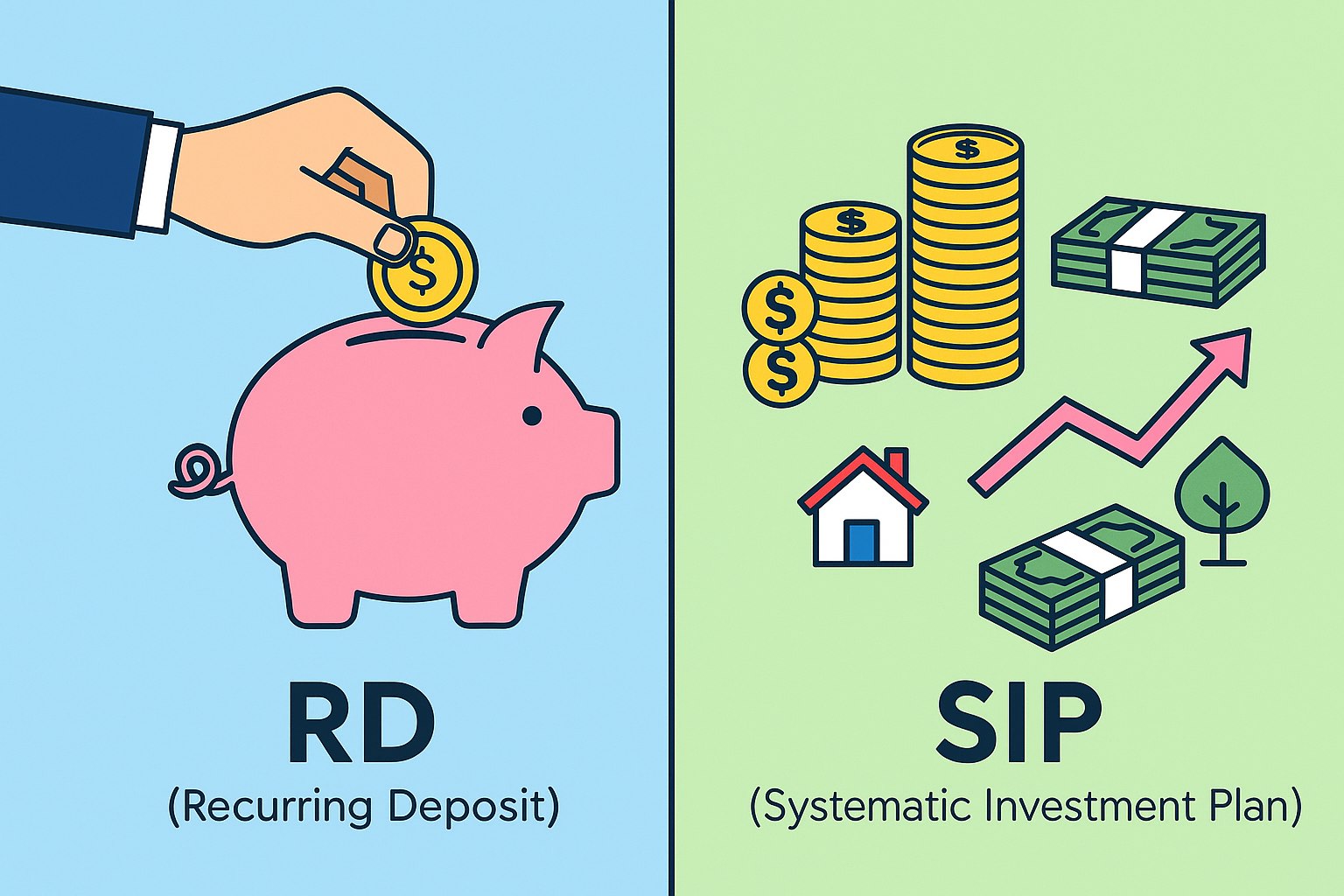
It is crucial to find investment options that coincide with the schedule and risk profile of each financial aim. The objective of goal-based investing is to link the correct instruments with your goals, such as mutual fund systematic investment plans (SIPs) for long-term growth and recurrent deposits (RDs) for short-term stability. Making better investing selections may be facilitated by applying the capabilities of a mutual fund SIP calculator and a recurring deposit calculator.
The Safety Net: Recurring Deposits for Near-Term Ambitions
Recurring deposits are a solid solution when there is a constrained time horizon and predictability is crucial. With RDs, investors may set away a certain amount each month and collect interest at a fixed rate until the investment matures. This makes them perfect for objectives like saving for a trip in a few years or establishing an emergency fund. Your maturity amount is automatically provided when you insert your term, interest rate, and monthly installments into a recurring deposit calculator. This affords you a clear, surprise-free perspective of your savings journey.
Riding the Growth Wave: SIPs for Long-Term Prosperity
Mutual fund SIPs present a strong alternative for purposes that are longer than five years, such saving for retirement or paying for college. SIPs leverage market cycles and compounding to invest in market-linked funds on a regular basis, possibly providing bigger returns. Investors may model their future wealth by inputting the investment period, estimated returns, and monthly payments into a mutual fund SIP calculator. This tool explains how, even in the face of market volatility, smart stock or balanced fund investment may build wealth over time.
Side-by-Side: The Calculator Duel
The mutual fund SIP calculator and the recurring deposit calculator are complementary tools that represent diverse investing techniques. With its guaranteed returns and principle protection, the RD calculator encourages predictability and is ideal for short-term, conservative purposes. The SIP calculator, however, highlights the promise of longer-term, larger returns via changeable, market-driven growth assumptions. By comparing the conclusions of the two calculators, investors may better appreciate risk-reward trade-offs and change their strategy to fit their specific objectives.
Crafting Your Investment Blueprint
Selecting between RD and SIP comprises more than simply returns; it also includes matching assets to your financial narrative. While long-term ambitions benefit from SIPs’ development potential, short-term demands need RDs’ stability. By applying the mutual fund SIP calculator and recurring deposit calculator, a tailored plan may be developed, successfully combining development and security to achieve a variety of aims.
Final Thoughts: Empowering Decisions with Digital Tools
Clarity and clarity are crucial for goal-based investment. With the assistance of their respective calculators, investors may deploy RDs for short-term aims and SIPs for long-term aspirations to get practical insights. These digital tools enable confident, well-informed judgments that help to financial success by transforming abstract financial planning into concrete forecasts.
By integrating these calculators into their investment planning, individuals can continuously monitor progress and make adjustments as needed, ensuring their portfolios remain aligned with evolving goals. This proactive approach not only enhances financial discipline but also builds confidence, making goal-based investing a practical and effective pathway to achieving both short-term stability and long-term prosperity.

Due to its potential to produce wealth over time, investing in mutual funds via Systematic investing Plans (SIPs) has grown more and more popular. SIPs benefit investors in building up a corpus, but if the corpus reaches a particular value, they may also choose to make a controlled withdrawal from their assets. A Systematic Withdrawal Plan (SWP) is applicable in this scenario. Investors may employ tools like the SIP Return Calculator and the SWP Calculator to anticipate the future value of their investments and transfer that amount into suitable monthly withdrawals in order to properly manage SIP investments and withdrawals.
Let’s understand SIP and SWP
Understanding what SIPs and SWPs are and how they operate is crucial before delving into the technical components of utilizing tools like the SIP return calculator and SWP calculator.
(SIP):
SIP is a disciplined approach of regularly investing a fixed amount in mutual funds. Investors may invest in mutual funds gradually applying this straightforward and affordable technique, which eliminates the need to timing the market. SIP is a well-liked solution for long-term wealth accumulation because of the prospects for market growth and the power of compounding.
(SWP):
The next stage for an investor is to manage withdrawals once they have built up a sizable corpus via SIPs. With SWP, investors may take out a specified amount from their mutual fund assets on a regular basis, often once a month. Those who desire a constant income from their assets, especially in retirement, will benefit from this technique.
What Makes a SIP Return Calculator Useful?
One tool that assists investors in predicting the future value of their SIP investments is a SIP Return Calculator. To estimate the projected rise of the invested total, it evaluates the monthly contribution amount, the predicted rate of return, and the investment period.
Features of an SIP Return Calculator:
- Input Variables: The tool requires three key inputs: the monthly investment amount, the expected rate of return, and the time horizon for the investment.
- Return Estimation: Based on these inputs, the calculator estimates the future value of the SIP, which gives the investor an idea of how much wealth they can accumulate by the end of the chosen investment period.
- Simple and Accurate: The SIP return calculator uses compounding to compute the future value, providing an accurate estimate of potential returns.
An investor may examine the expected growth of their SIP investments over time and establish appropriate financial aims by employing the SIP return calculator.
Converting Future SIP Value to Monthly SWP
The next stage is to implement an SWP (Systematic Withdrawal Plan) to turn the SIP investment into a continuous income stream when its future value has been assessed. The SWP Calculator, which assists investors in figuring out how much they may withdraw each month while maintaining their money, is utilized to accomplish this.
An SWP Calculator’s Features:
- Input Variables: The SWP calculator requires inputs like the total corpus (future SIP value), the desired monthly withdrawal amount, and the investment duration.
- Flexible Withdrawals: The SWP calculator can be adjusted to generate different withdrawal amounts, depending on the investor’s needs and financial goals.
- Capital Preservation: The calculator ensures that the withdrawals are spread across a period, so the capital is not completely exhausted too soon.
Final Thoughts on Using SIP and SWP Calculators
Using the SIP return calculator and SWP calculator is a vital method for anybody desiring to build their wealth via SIP investments and later convert their corpus into a steady monthly income via SWP. Transparency, ease, and a rigorous approach to controlling withdrawals and investments are supplied by these systems.

In the fast-moving world, being in control of finances and making good investments can be difficult. Fortunately, the journey has been made easier through digital tools. These tools assist in saving time, creating less paperwork, and providing a clear understanding of our financial goals. A SIP investment calculator can tell you how much to invest monthly to achieve your goal. With just a few clicks, anyone can start creating a secure financial future, even without a finance background.
Tools for Your Investment Journey: From Demat Account to Using an SIP Calculator
These tools provide convenience and assist you in remaining relevant and making decisions. Let’s understand these tools in detail:
1. Opening A Demat Account: A Demat account is like a digital locker where you can put your things in electronic shares, which can be easily and quickly accessed. In the same way, one requires a bank account for the safekeeping of money; one also needs a Demat account as a storehouse for the securities they possess in the stock market. By having such an account, you can easily trade, i.e., purchase and sell shares without needing physical paperwork.
2. Trading Account: Supposing a Demat account possesses your stocks, a trading account is the money used to purchase and sell them in the stock market. For example, the Demat account can be likened to a piggy bank where you keep your money. Your portfolio is stored in your Demat account, while the trading account enables you to trade. These accounts are perfect for facilitating trading, which is profitable and correct, and is ethically right.
3. SIP (Systematic Investment Plan): It is a convenient method for investing small amounts in mutual funds. Instead of making a large investment in one go, SIP enables you to put in a fixed amount every month. This encourages the practice of saving at regular intervals and hedges your risks associated with the market’s volatility to a certain extent. SIP is simpler and safer for less experienced investors who want to multiply their funds slowly but steadily.
4. Portfolio Tracker: By using a portfolio tracker, one can get a comprehensive view of all their investments, such as stocks, mutual funds, SIPs, and other investments. The tracker provides an overview of how much you have invested, the growth of your money, and the investments that are doing well. Moreover, the availability of such tools is one of the best features of today’s brokers’ apps and financial websites.
5.Mobile Investment App: Having investment applications at your disposal will enable you to control your finances easily. You can get your apps on your mobile phone and make good use of them to visit your portfolio, invest in stocks or mutual funds, and catch up with the financial markets. These are the kind of apps that you would like to use, and the good thing about them is that they are designed for those who are not in any way related to finance.
Final WordsTo sum up, getting started with your investing journey will not be easy, but every successful investor starts with one step at a time. The earlier you begin, the more time your money has to increase. Be focused, learn as you learn, and have faith in the process. To start your journey, make the first move and open demat account online with a trustworthy provider. Opportunities don’t come at your convenience, and neither should you prefer. Make your money work for your future.


Cadillac LYRIQ Driving Modes: Do They Specify a Range or Battery Usage?

Blooket.com: The Game-Based Learning Platform That Makes Classrooms More Engaging

Sarah Boe: Who Is Alfie Boe’s Former Wife?

Best Gaming Website Wheon com Games in 2025

How to Generate Passive Income with 5starsstocks.com